Showing posts with label Tools. Show all posts

Sunday, April 19, 2009

Pirates Past Noon Ages 7 - 8

Pirates Past Noon
By Mary Pope Osborne, Sal Murdocca
Illustrated by Sal Murdocca
Edition: illustrated
Published by Random House, 1994
ISBN 0679824251, 9780679824251
67 pages Age 7, 8
Illus. in black-and-white. Jack and Annie are in deep trouble when the Magic Tree House whisks them back to the days of desert islands, secret maps, hidden gold--and ruthless pirates! Will Jack and Annie discover a buried treasure? Will they find out the identity of the mysterious M? Or will they walk the plank?
Activities Resource
Other Resources

Monday, April 13, 2009

Teach Reading with TV Closed Captioning & Recorded Books


THE most economical device to teach
reading is already in your home.
Finland’s
children have the highest reading
scores in the world and they use
this device
more than any other country
—and it’s free!

It’s closed-captioning on the TV.
Turn it on by
using the “menu” button
on the remote to
reach the “cc” area.
Children unconsciously
absorb the sight
of the words and their
sounds,
making connections to how print is
used.
It’s like having a free magazine subscription
in the home.
All print counts.
What
about recorded books—do they count?
Read on.

WHILE a recorded voice is not as good as
a live adult who can stop and explain something
in the story, it’s better than nothing.
It’s
also a great assist for the parent
who has
a reading disability or
for
whom English is a second language.
(Incidentally,
reading to a child
in a foreign
language accomplishes
many of the
same things
—feeds vocabulary and builds a

bridge to the love of reading and books.)
Public libraries have huge collections of
audio books—all available for free.

http://www.trelease-on-reading.com/10-reading-facts-brochure.pdf

Jim Trelease Read Aloud Handouts about Reading

"Do you have a free handout about reading
that we can give parents at our school?"

o many teachers and administrators asked Jim Trelease that question, one of his first retirement projects was to create a series of such free handouts. Based on his books, lectures, and films, the tri-fold double-sided brochures are aimed at parents, teachers, librarians—even future teachers and parents.

Written in an uncomplicated, to-the-point style, along with some of the charts and statistics Jim has used in his books and lectures, the brochures are free for downloading and may be easily duplicated by nonprofit institutions dealing with parents and community members.

The subject matter includes:

  • Why reading is the most important subject in school;
  • How a child becomes competent in reading;
  • The importance of a child reading outside school;
  • Why it's essential for parents to read aloud to children;
  • Listening levels versus reading levels;
  • How the mere presence of print in the home influences a child's reading skills;
  • The negative impact of over-viewing of TV and video games;
  • How TV's "closed-captioning" can help a child's reading;
  • The positive effects of recorded books.
  • The things to be sure to do when reading to children and the things to avoid;
  • Why is it that some people read a lot and some (even very educated people) read very little?

How do we obtain the brochures?

First, email Jim Trelease (Jim Trelease) and seek permission to print the brochures, including in your correspondence the name and address of the requesting organization, its nonprofit status, and how it will be used. Jim's email response to you (usually within 48 hours) will allay any fears your printer may have about reprinting a copyrighted item. Then control/option-click on the name of the brochure below and the brochure's PDF file will be downloaded to your computer. Each is a megabyte in size and may take a minute to download. Burn it to a disc (or email it) for your printing facility. The item should be printed to both sides of a single sheet. It's easier than pie, if you've ever tried to bake a pie—a lot easier!

spacer
New Children's Literature
* * * REVIEWS * *
*

http://www.trelease-on-reading.com/whatsnu-reviews.html

Sunday, April 12, 2009

Wilfrid Gordon McDonald Partridge
By Mem Fox
Illustrated by Julie Vivas
http://www.storylineonline.net/
Edition: illustrated, reprint
Published by Kane/Miller Book Publishers, Incorporated, 1989
ISBN 091629126X, 9780916291266
30 pages Ages 3, 4, 5, 6, 7, 8, 9

AUTHOR WEBSITE
Read by BRADLEY WHITFORD.
Young W.G.M.P. wasn't very old. He lived next door to an old people's home and he knew all the people there and enjoyed their company. His favourite person of all was Miss Nancy Alison Delacourt Cooper, because she has four names just as he did.

Friday, April 10, 2009

When Pigasso met Mootisse Storyline Online AudioBook

When Pigasso met MootissePREVIEW
http://www.storylineonline.net
Edition: illustrated
Published by Chronicle Books, 1998
ISBN 0811811212, 9780811811217
40 pages Ages: 4, 5, 6, 7, 8, 9, 10
Read by ERIC CLOSE.
When Pigasso met Mootisse, what began as a neighborly overture escalated into a mess. Before you can say paint-by-numbers, the two artists become fierce rivals, calling each other names and ultimately building a fence between them. But when the two painters paint opposite sides of the fence that divides them, they unknowingly create a modern art masterpiece, and learn it is their friendship that is the true work of art. Full color throughout.
During their youth in Paris, Picasso and ...
... Matisse had a brief falling out after a competitive spat. Here, art imitates life as Laden takes that episode and, through transformation and embellishment, turns it into neat little lessons in art history and ego reduction. Pigasso and Mootisse have separately garnered such fame that they each must flee the hordes to concentrate on their art. When they become neighbors in the countryside, all is bonhomous until their temperaments--and their artistic visions--clash, so much so that they build a great wooden fence between their houses. Gradually their hearts soften. To make amends, and since neither knows how to simply apologize, each simultaneously paints a tribute to the other (and, of course, to himself, as befits such self-importance) on the fence. There are plenty of good (modified) examples of the real artists' works, as well as a couple of surprises, such as a Jackson Pollock--style explosion between the painters. The characters come across as bumptious, strong-willed, and appealing. Laden further lightens the story with goofy wordplay--moosterpiece, pork of art--that adds little when the quality of the artwork and the book's detonation of color are already such pleasures.
Kirkus Reviews Copyright (c) VNU Business Media, Inc.

A Bad Case of Stripes Storyline Online AudioBook

A Bad Case Of Stripes
By David Shannon
http://www.storylineonline.net/
Illustrated by David Shannon
Published by Demco Media, 2004
ISBN 0606305815, 9780606305815 Ages 6, 7, 8, 9
Read and Acted by Sean Astin
In order to ensure her popularity, Camilla Cream always does what is expected, until the day arrives when she no longer recognizes herself.
RearWriteThink Lesson Plan
After she refuses to eat her lima beans, Camilla finds herself covered with stripes. The stripes change into stars, polka dots, and other patterns. Camilla overcomes her "illness" when she learns to be herself. INDIVIDUALITY, POPULARITY

My Rotten Redheaded Older Brother Storyline Online AudioBook

My Rotten Redheaded Older Brother
By Patricia Polacco
PREVIEW
http://www.storylineonline.net/
Illustrated by Patricia Polacco
Edition: illustrated
Published by Simon & Schuster Books for Young Readers, 1994
ISBN 0671727516, 9780671727512
32 pages Ages 4, 5, 6, 7, 8
Wonderful animated reading aloud by MELISSA GILBERT.
USE THIS FOR READER'S THEATER.
There's nothing worse than a rotten redheaded older brother who can do everything you can do better! Patricia's brother Richard could run the fastest, climb the highest, and spit the farthest and still smile his extra-rotten, greeny-toothed, weasel-eyed grin. But when little Patricia wishes on a shooting star that she could do something -- anything -- to show him up, she finds out just what wishes -- and rotten redheaded older brothers -- can really do. Patricia Polacco's boldly and exuberantly painted pictures tell a lively and warmhearted tale of comic one-upsmanship and brotherly love.
Patricia has an older brother who looks ...
... ""like a weasel with glasses,"" but that's just for starters. The real problem with him -- besides his red wiry hair and his freckles -- is that he's always telling her he can do everything better than she can. He can pick more blackberries, he can eat more rhubarb without puckering; he can run faster, climb higher, burp louder, and spit farther. Worst of all, he's four years older, ""always has been and always will be."" When Patricia's babushka -- her grandmother -- teaches her how to wish on a falling star, Patricia wishes to do something better than he does. She gets her wish and winds up seeing a different side of her brother as well. Polacco's (Babushka Baba Yaga, 1993, etc.; Pink and Say, see below) text is smooth, effortless, and completely natural-sounding. Her drawings are funny and vivacious -- as usual, her characters are drawn with wonderful facial expressions and limbs akimbo. She has the ability to transport you to her settings -- in this case, to a Michigan farm where you can practically feel the sun and smell the pies baking. Polacco has proved time and again that she is masterful both as illustrator and storyteller, and this book is no exception.
Kirkus Reviews Copyright (c) VNU Business Media, Inc.
Barnes and Noble Info

Thank You, Mr. Falker Storyline Online Audiobook

Thank You, Mr. Falker
Illustrated by Patricia Polacco
Edition: illustrated
Published by Book Wholesalers, Incorporated, 2002
ISBN 0758737793, 9780758737793 Ages 5, 6, 7, 8, 9, 10,11

Little Trisha is miserable because she can't read. One day a new teacher recognizes Trisha's secret and sets out to help her overcome her problem

An autobiographical tribute to Polacco's ...
... fifth-grade teacher, the first adult to recognize her learning disability and to help her learn to read. Trisha begins kindergarten with high hopes, but as the years go by she becomes convinced she is dumb. She can draw well, but is desperately frustrated by math and reading. In fifth grade, Mr. Falker silences the children who taunt Trisha, and begins, with a reading teacher, to help her after school. A thank-you to a teacher who made a difference is always welcome, but this one is unbearably sentimental. Although the perspective is supposed to be Trisha's, many sentences give away the adult viewpoint, e.g., ""She didn't notice that Mr. Falker and Miss Plessy had tears in their eyes."" The extent to which Trisha limns her own misery and deifies Mr. Falker (complete with a classroom version of a ""He who is without sin among you"" scene) is mawkish. Mr. Falker's implicit sense of fairness--""Right from the start, it didn't seem to matter to Mr. Falker which kids were the cutest. Or the smartest. Or the best at anything""--is contradicted when Trisha is the object of praise: Mr. Falker, watching her draw, whispers, ""This is brilliant . . . absolutely brilliant. Do you know how talented you are?"" Polacco's disdain for all the other teachers and the students intrudes on Trisha's more profoundly heartbreaking perspective; the book lacks the author's usual flair for making personal stories universal.
Kirkus Reviews Copyright (c) VNU Business Media, Inc.
SEND A POSTCARD

Sophie's Masterpiece Storyline Online AudioBook

Sophie's Masterpiece: A Spider's Tale
By Eileen Spinelli, Jane Dyer
http://www.storylineonline.net/
Illustrated by Jane Dyer
Edition: illustrated
Published by Simon & Schuster Books for Young Readers, 2001
ISBN 0689801122, 9780689801129
32 pages
Sophie's no ordinary house spider. She's an artist; and every web she spins is more wondrous than the one before. But don't mention that to the guests at Beekman's Boardinghouse, because they don't like spiders. No one there wants anything to do with Sophie or her magnificent creations -- no one except the woman on the third floor. She's a new mother "weaving" something herself; and when she runs out of yarn, Sophie knows the time has finally come to create the masterpiece of a lifetime.

Eileen Spinelli and Jane Dyer, the award-winning duo who created the best-selling When Mama Comes Home Tonight, team up once again to tell the charming and bittersweet tale of an exceptionally gifted spider and the lengths she's willing to go to share her gifts with those around her.

The creators of When Mama Comes Home ...

... Tonight (1998) weave another affecting tale, in which a gentle, eight-legged artist spends her last strength on a gift to a newborn baby. Though Sophie's ingeniously patterned webs are the delight of her Mama and playmates, when she moves into a drab boarding house, its residents react to her presence with fear and disgust. Most of its residents, that is—weary and aging, Sophie finds a home and quiet welcome at last when she crawls into an expectant young mother's yarn basket. Sophie's webs, all finer than the finest lace, ripple with stars, flowers, and geometric patterns in Dyer's delicately detailed watercolors. She herself cuts a stylish bohemian figure, with long, slender legs in multicolored stockings radiating from a black body topped by a flaxen-haired human head. Learning that the young woman is too poor to knit or buy a blanket, Sophie gathers strands of moonlight, wisps of night and pine, old lullabies, snowflakes, and, last of all, her own heart to create a gift that the new mother receives with "love and wonderment." Sophie may physically resemble the proud, angry protagonist of Kate Hovey's Arachne Speaks (2000), but her generosity of spirit gives her a very different character. (Picture book. 7, 8, 9)
Kirkus Reviews Copyright (c) VNU Business Media, Inc.

Sebastian's Roller Skates Storyline Online AudioBook

Sebastian's Roller Skates
By Joan De Deu Prats, Joan De Prats
http://www.storylineonline.net/
Illustrated by Francesc Rovira
Edition: illustrated
Published by Kane/Miller, 2005
ISBN 1929132816, 9781929132812
32 pages
Sebastian doesn't talk much, even though he has a lot to say. But a pair of roller skates may unlock more than Sebastian's coordination?
In this story about the power of self ...
...-confidence, Sebastian is a reserved boy to the point of stifling shyness. He lives within his thoughts, unable to express himself to others, though full of fascinating ideas. When an abandoned pair of roller skates piques his interest, he tries to learn to skate with a quiet determination. Alas, his fear of falling down and failing prevents him from becoming proficient. An impromptu rescue of a runaway dog provides the impetus he needs to use his new skills on skates—instilling him with confidence and unleashing his self-restraint. Rovira skillfully conveys the changing tenor of Sebastian's moods in a distinctive manner: The illustrations are primarily full-bleed watercolor and ink; however, he uses his collages to indicate Sebastian's internal thoughts. At first, the collages consist of monochromatic ripped pieces of paper, full of detail, but in blacks and grays. As Sebastian overcomes his reticence, the collages increase in clarity and vibrancy until tale's end where they become a torrent of joyful, brightly colored images. Sebastian's triumph provides inspiration for timid readers to seek out their own strengths. (Picture book. 5, 6, 7, 8, 9)
Kirkus Reviews Copyright (c) VNU Business Media, Inc.

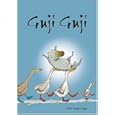
Guji Guji Storyline Online AudioBook

Guji Guji
By Chih-Yuan Chen, Zhiyuan Chen, María Fernanda Pulido Duarte
PREVIEW
http://www.storylineonline.net/
Translated by María Fernanda Pulido Duarte
Illustrated by Chih-Yuan Chen
Edition: illustrated
Published by Kane/Miller Book Publishers, Inc., 2007
ISBN 1933605340, 9781933605340 Ages 3, 4, 5, 6, 7, 8, 9
36 pages Read ROBERT GUILLAUME the voice of Rafiki in The Lion King
Raised from an egg by Mother Duck, Guji Guji is quite content with his life as a duckling, despite the fact that he doesn't look anything like his brothers. Then he meets three nasty creatures who not only convince him that he is, like them, a crocodile, but also try to persuade him to deliver his duck relatives for their dinner. Suggested level: junior, primary.
PreS-Gr 3-One day, an extra-large egg ...
... rolls right into Mother Duck's nest. She is busy reading and doesn't notice the new addition, but this lucky event will change her life. Her hatchlings include a yellow duckling; one with blue spots; another with brown stripes; and a rather unusual, crocodile-shaped youngster, named after his first words. Guji Guji grows bigger and stronger than his siblings (and more crocodilelike), but Mother loves all her offspring the same. When three duck-hungry crocodiles make fun of Guji Guji's ways and try to tempt him into betraying his family, he is put to the test. This beautifully written story has much to say about appreciating families and differences, and it will resonate with children long after the final page is turned. Chen's unique illustrations are compelling, down to the beautiful silhouette endpapers. The rich blues and earth tones and dramatic page layouts create moving scenes, but the quirky details and characters' expressions are hilarious. This charming spin on the ugly duckling theme is a must-have for any collection.-Julie Roach, Malden Public Library, MATAIWAN REVIEW

To Be a Drum Storyline Online AudioBook

To Be a Drum
Illustrated by Aminah Brenda Lynn Robinson
Edition: illustrated
Published by Albert Whitman and Company, 2000
ISBN 0807580074, 9780807580073
32 pages Ages 5, 6, 7, 8, 9
Read by JAMES EARL JONES who discusses his reluctance to speak, his stuttering, and his dyslexia.
Daddy Wes tells his children Mat and Martha that the drum has long been a powerful symbol to their African roots, and shares with them how the drum was the underlying heartbeat of their people through slavery, war, and the civil rights movement. Full-color illustrations.
The drum is a mytho-poetic symbol that ...
... links people to their African roots and to the rhythm of the earth, or so Daddy Wes tells his children, Mat and Martha. In broad sweeps of history--covering slavery, war, civil rights--and in the struggle for intellectual and artistic pursuits, Daddy Wes declares that the underlying heartbeat of a people is the drum. Metaphorically extending the idea, he explains that when the literal drum was taken from the slaves, the rhythm was internalized: ""When we talked to each other, we made our speech drums. When we stitched our quilts, we made our hands drums."" The message hovers, rising from the core of African-American experience, even when the image becomes abstract, even when the moralizing momentarily overtakes the drumbeat. That's the moment, in this joyful and robust chronicle, to turn to the art, where the energetic montages bustle with multi-textured backgrounds and figures, employing cloth, cotton, old buttons, sisal, wool, clay, and more, in theatrical, pulsing settings.
Kirkus Reviews Copyright (c) VNU Business Media, Inc.

Stellaluna Storyline Online AudioBook

Stellaluna
Edition: illustrated
Published by Houghton Mifflin Harcourt, 2007
ISBN 0152062874, 9780152062873
42 pages
Stellaluna has been charming picture-book readers for years with its moving tale of a lost little bat who learns a big lesson about friendship. This bestseller has now been adapted as a board book, the perfect format to introduce younger readers to Janell Cannon's enchanting tale and gorgeous art.

Attacked by an owl, Stellaluna (a fruit ...
... bat) is separated from her mother and taken in by a bird and her nestlings. Dutifully, she tries to accommodate--she eats insects, hangs head up, and sleeps at night, as Mama Bird says she must--but once Stellaluna learns to fly, it's a huge relief when her own mother finds her and explains that the behavior that comes naturally is appropriate to her species. With a warm, nicely honed narration, Cannon strikes just the right balance between accurate portrayal of the bats and the fantasy that dramatizes their characteristics. Her illustrations, in luminous acrylics and color pencils, are exquisite. The appealingly furry, wide-eyed, fawn-colored bats have both scientific precision and real character; they're displayed against intense skies or the soft browns and greens of the woodland in spare, beautifully constructed (occasionally even humorous) compositions. Delightful and informative but never didactic: a splendid debut. (Picture book. 4, 5, 6, 7, 8)
Kirkus Reviews Copyright (c) VNU Business Media, Inc.

Storyline Online AudioBooks

http://www.storylineonline.net/

Screen Actors Guide Foundation

Online Streaming Video Program

featuring SAG members

reading Children's Books aloud.

See and Hear the Actor and the Book!

Ages 3, 4, 5, 6, 7, 8, 9, 10, 11, 12

LibriVox Downloadable AudioBooks Public Domain


I'd like to share a Web site called

LibriVox,

which provides free, downloadable audiobooks from the public domain: Users download the audiobooks in MP3 format and listen to them on their computer or copy them onto an MP3 player. According to the site, "LibriVox volunteers record chapters of books in the public domain and release the audio files back onto the Internet. Our goal is to make all public domain books available as free audiobooks." Users can take advantage of the full catalog of audiobooks -- about a thousand at the time of this writing.

Because the books are in the public domain, users may listen to them as many times as they want and share them with others. If your students have access to MP3 players, providing them with audiobooks is a great way to encourage their appreciation for some fantastic literature. In addition, you can sign up to be a volunteer reader: Find a book of your choosing in the public domain, and record yourself reading it. The site, started in 2005 for the sole purpose of sharing the love of reading, works on a volunteer basis.

LibriVox is a teacher's dream -- a fun tool to encourage the reluctant reader or inspire your already-addicted ones to explore even more great literature. You'll find Aesop's Fables and the works of Shakespeare, James Joyce, and Rudyard Kipling -- the list goes on and on. How about some Edgar Allan Poe to listen to on the way home from school each evening?

Go have a listen, and let us know what you think.

Wednesday, April 8, 2009

Literacy in TWENTY MINUTES A DAY

How many books in Twenty Minutes a Day?

THE READ-ALOUD BOOK by Jim Trelease

USA Today's (March 19, 1991) Dennis Kelly calculated that reading twenty minutes a day, six days a week, the average reader would accumulate 104 hours in a year and 3000 pages.
The 3000 pages are the equal of Dickens' Bleak House, Little Dorrit, Great Expectations, and Our Mutural Friend; or five novels by Judith Krantz; or twenty-one John D. Macdonald mysteries.
On the other hand, if you convert the 104 hours to television shows, it comes out to about eight seasons of Roseanne.

Robert Anderson and other researchers conducted the mosst comprehensive study ever done on how children spend their time outside school and compared reading scores from when they were in second grade with their scores in fifth grade. They reported:
  1. Students who read the most also had the most success in reading between second and fifth grades.
  2. Students who spent more time eating with their families had higher reading achievement.
  3. Students who read the most came from classrooms where the teachers most frequently:
  • read aloud to the class
  • made a wide assortment of books available to the class
  • used incentives to motivate students
  • scheduled sustained silent reading during the school day
National Reading Incentive Programs:
Pizza Hut's Book It! http://www.bookitprogram.com/
Reading is Fundamental http://www.rif.org/
RIF's READ ALONG STORIES FOR KIDS
Animated Stories read & Story Songs sung aloud with highlights word by word.
Mice-tro Mozart: the Opera House Mouse
Calico Pie - Story Song
Reading Rainbow http://pbskids.org/readingrainbow/
Sylvan Learning http://www.bookadventure.org/
Get Caught Reading http://www.getcaughtreading.org/
Send an eCard or join the National Geographic Kids Blog

Thursday, April 2, 2009

Gotcha for guys!: nonfiction books to get boys excited about reading

Preview this book
By Kathleen A. Baxter, Marcia Agness Kochell
Edition: illustrated, annotated
Published by Libraries Unlimited, 2007
ISBN 159158311X, 9781591583110
269 pages
Research indicates boys are interested in reading nonfiction
materials, yet most children's librarians prefer to booktalk fiction.
Offering citations for more than 1,100 books, Gotcha for Guys!
deals specifically with books to pique the interest of middle grade boys.
A series of booktalks are grouped within chapters with like titles
such as: "Creepy-Crawly Creatures," "Disasters and Unsolved Mysteries,"
"Action and Innovation," and "All Things Gross."
Complete booktalks are presented in a beginning section of chapters 1-9.
A second section in each of these chapters contains short
annotations and talks for other books of interest,
and a third section offers lists of well-reviewed titles to consider for boys.
The book is enhanced with book cover art and reproducible lists
for teachers and librarians.

Contents

1
Hitler Youth , Chiune Sugihara , Candlewick Press
23
African American , Freedom Riders , Kid Blink
51
Pterosaur , John Bindon , Feathered Dinosaurs
67
Kids Can Press , Science Verse , HarperCollins
95
mummies , Grossology , Zahi Hawass
112
White Sharks , Grades K-3 , naked mole rats
159
Minibeasts , Komodo Dragon , Africanized bees
175
Inside the NFL , X-treme Sports , Half-Pipes
205
Forensic Files , H.L. Hunley , Roanoke Colony
223
Ripley's Believe , Harpster , Ed Emberley
233
National Geographic Society , Sandra Markle , Publications Company
243

251
Triceratops , Dan Greenberg , Tyrannosaurus

Kids Can Press, Sandra Markle, HarperCollins, Grades K-3, National Geographic Society, Zahi Hawass, Mummies, Pterosaur, H.L. Hunley, Inside the NFL, Gotcha Again, Candlewick Press, Atheneum Books, White Sharks, Grades 4-up, Lerner Publishing, Ed Emberley, Grossology, Science Verse, Heinemann Library

Gotcha!: nonfiction booktalks to get kids excited about reading

Preview this book
By Kathleen A. Baxter, Marcia Agness Kochel
Edition: illustrated
Published by Libraries Unlimited, 1999
ISBN 1563086832, 9781563086830
183 pages
Thousands of children's books are published each year
-some are outstanding, while others are not.
This book makes it easier for you to find the best
in children's nonfiction books, and it offers concrete,
classroom-tested ideas for presenting them to students
in irresistible ways. Booktalks for more than 350
nonfiction titles (appropriate for elementary
and middle school students) are organized according
to topics popular with young readers
-"Great Disasters," "Unsolved Mysteries," "Fascinating People,"
"Science," and "Fun Experiments to Do." In addition,
there are tips on booktalking, an outline for a booktalk program,
and a bibliography that can be used for collection development.
Appropriate grade levels for each book are cited.
Library Media Specialists will find this guide essential.
The thematic approach helps teachers search for titles
that correlate to curriculum areas or specific units of study.
Parents can use the book with their children
as a reading selection tool. Anyone who works
with young children will find this book an invaluable resource.

Contents
2
Donner Party , Pompeii , Atocha
21
mummies , Jack Prelutsky , Ankylosaurus
41
dinosaurs , Harp Seal , lemurs
73
UFOs , Amelia Earhart , Yeti
89
Warren Faidley , Skara Brae , Spencer Christian
112
African American , Laura Ingalls Wilder , Peg Kehret
Our Wonderful Terrible Past
141
African American , Underground Railroad , Rhoda Blumberg
173

6
dinosaurs , Harp Seal , Underground Railroad

100 Most Popular Children's Authors: Biographical Sketches and Bibliographies

Front Cover
By Sharron L. McElmeel
Edition: 5, illustrated
Published by Libraries Unlimited, 1999
ISBN 1563086468, 9781563086465
495 pages
Students can learn more about their favorite authors
and find plenty of reading materials they'll enjoy
with this affordable biographical work and ready-reference.
Featuring 100 beloved and celebrated children's book authors,
McElmeel offers engaging biographical sketches, photos,
and selected bibliographies and lists of related information sources.
Included are such long-time luminaries as Beverly Cleary
and Marguerite Henry as well as many new emerging writers.
McElmeel's focus is on contemporary authors
and those whose works are still in print. A more current
and affordable alternative to multivolume publications,
this book is a great collection development tool and
resource for author studies. Students will enjoy using it
for their reports and research papers.

Reviews

Gr 6-9-This handy resource provides
fairly extensive biographical information about writers enjoyed by elementary and middle school children. Authors of contemporary and classic novels and nonfiction titles are included. For each entry, several pages of background are followed by a selective, sometimes annotated book list of the person's works and several titles for further reading. This inconsistent use of annotations is bothersome. Occasional Web sites are also given. Clearly, depth of coverage can't be as complete as the multivolume Something about the Author (Gale) or the Biography Today: Author Series (Omnigraphics), but McElmeel more than adequately covers each writer's life and work. "Most popular" is always open to interpretation, and obviously not everyone will agree with this designation. Many of the writers are also found in Bernard Drew's The 100 Most Popular Young Adult Authors (Libraries Unlimited, 1997). There are black-and-white photos of fewer than half the entries. Helpful genre and general indexes conclude the volume. For libraries owning any of the biographical sets, this is not a first purchase. However, its accessible format will make it the preferred title to answer general questions. Useful for collections serving teachers and students.-Peg Glisson, Mendon Center Elementary School, Pittsford, NY