Showing posts with label Creativity. Show all posts

Monday, April 27, 2009

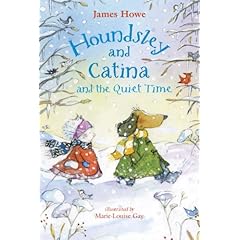
Houndsley and Catina and the Quiet Time Ages 4-8

The creators of the E. B. White Read Aloud winner HOUNDSLEY AND CATINA offer a charming sequel about taking time out from the hustle and bustle.
The first snow of winter has fallen, and Houndsley is very happy, as he loves the quiet time. Catina does not like the quiet time, however, and she does not enjoy being snowed in. What about all her plans for the day? What if their evening concert has to be canceled? With a bit of pretending, a few books and board games, a flourish of creativity, and
some time to dream, Houndsley helps Catina let go of her worries and enjoy the snowy day, wherever it might take them.
Houndsley and Catina and the Quiet Time
By James Howe, Marie-Louise Gay
Illustrated by Marie-Louise Gay
Edition: illustrated
Published by Candlewick Press, 2008
ISBN 0763633844, 9780763633844
42 pages
From Booklist
Emergent readers will enjoy the latest outing featuring this appealing cat-and-dog friendship. The first winter storm finds the duo snowed in while preparing for the evening’s community concert. Houndsley loves the quiet time, while Catina is hopping mad that she is stuck inside. Finally, neighbors shovel them out and the concert takes place after all. Gay’s delicate watercolors capture the delight of a wintry day, and Howe’s on-target portrayal of friends who get along despite bumps along the way make this special. Grades K-2, ages 4, 5, 6, 7, 8. --Bina Williams

Sunday, April 12, 2009

KinderSITE Ages 2 - 12 in 12 languages & 157 countries


http://www.kindersite.org/

Twelve foreign languages plus English

Welcome
to the Kindersite Project for ALL preschool and Kindergarten age children and English learners.

The Kindersite has 1,000s of links to the best games, songs and stories for young children.

The Kindersite is designed for kinder, child-care, preschool, kindergartens, elementary, primary schools and Special needs plus homeschool, libraries and the home. In fact everywhere where young children access computers.

To use the Kindersite content

Your child's safety is our foremost concern, every link and site that the Kindersite uses has been checked as conforming to Department of Children, Schools and Families (UK) guidelines for safe sites for children.

News - The Kindersite is growing, see the new 'Educational Games' for 7 to 12 year olds or teachers and parents can learn more about this new feature

News - Animated lullabies in 7 languages have been added to the Kindersite plus 35 sample lullabies. These are a result of a funded education project

News - The Kindersite has now received registrations from 17,108 schools and authorities in 157 countries

News - Prof. Dr. Mª Dolores Ramírez Verdugo Ph.D. (Autonomous University of Madrid) has recently had a refereed research published, on using the Kindersite for ESL
Ages: 2, 3, 4, 5, 6, 7, 8, 9, 10, 11,12

Friday, April 10, 2009

Sebastian's Roller Skates Storyline Online AudioBook

Sebastian's Roller Skates
By Joan De Deu Prats, Joan De Prats
http://www.storylineonline.net/
Illustrated by Francesc Rovira
Edition: illustrated
Published by Kane/Miller, 2005
ISBN 1929132816, 9781929132812
32 pages
Sebastian doesn't talk much, even though he has a lot to say. But a pair of roller skates may unlock more than Sebastian's coordination?
In this story about the power of self ...
...-confidence, Sebastian is a reserved boy to the point of stifling shyness. He lives within his thoughts, unable to express himself to others, though full of fascinating ideas. When an abandoned pair of roller skates piques his interest, he tries to learn to skate with a quiet determination. Alas, his fear of falling down and failing prevents him from becoming proficient. An impromptu rescue of a runaway dog provides the impetus he needs to use his new skills on skates—instilling him with confidence and unleashing his self-restraint. Rovira skillfully conveys the changing tenor of Sebastian's moods in a distinctive manner: The illustrations are primarily full-bleed watercolor and ink; however, he uses his collages to indicate Sebastian's internal thoughts. At first, the collages consist of monochromatic ripped pieces of paper, full of detail, but in blacks and grays. As Sebastian overcomes his reticence, the collages increase in clarity and vibrancy until tale's end where they become a torrent of joyful, brightly colored images. Sebastian's triumph provides inspiration for timid readers to seek out their own strengths. (Picture book. 5, 6, 7, 8, 9)
Kirkus Reviews Copyright (c) VNU Business Media, Inc.

Wednesday, April 8, 2009

Making Musical Instruments Charlotte, NC

Making Musical Instruments - Carol Raedy,
a musician and educator from Charlotte, NC,
has put instructions online for making simple musical instruments.
Using common household items you can guide your students
to make a banjo, bass, dulcimer, drum, rainstick, and thumb piano.

Monday, April 6, 2009

The Usborne Book of Secret Codes


Usborne Books
The Usborne Book of Secret Codes
by Diana Riddel

Grades: 3 - 5
Paperback Book
0.149 x 7.855 x 9.882
32 pp.
Item #:NTS63152
Weight (lbs):0.206 This informative series featuring favorite subjects brings the excitement of discovery to curious readers. Whether enhanced by full-color photographs, stunningly realistic artwork, cutaway diagrams, amusing illustrations, or step-by-step guides, these materials immerse and engage.

This fascinating how-to book allows kids to create and use their own codes - all kinds of secret codes, some based on the alphabet, on grids, on calendars, or on numbers and dots. A story is told throughout the book that can be followed only by using the demonstrated codes.
Scholastic Store $5.95

Sunday, April 5, 2009

Hands On Crafts in North Carolina

http://www.handsoncrafts.org/

Come Play!

Try this site for interactives! Learn about
Pottery Making in Studio 1
and

Basket Weaving, Textile Weaving and
Quilt Making in Studio 2
.

There is a Road Trip through North Carolina
to Web Sites for for Arts and Crafts and Library sites.

Saturday, April 4, 2009

Imagine a Dragon Ages 7-9


You might think Imagine a Dragon would be collection of fluffy poems going nowhere special, but you’d be wrong. Instead, esteemed science writer Laurence Pringle has compiled a treasury of true stuff about this beast, illustrious but wholly imaginary. Starting with the earliest rumors in China, Egypt, and present-day Iraq, a dragon worked nicely as an explanation for natural disasters, scientific phenomena, anything that seemed scary. Pringle zooms around the globe to glean the primo dragon facts and legends, while lush paintings in acrylic by Eujin Kim Neilan make the pages swirl. Good example of a handsome nonfiction picture book, and an appealing choice for kids shifting out of fairy tales (Boyds Mills, 2008, ages 7, 8, 9). FROM:

Friday, April 3, 2009

Second Interview with Ed Beard, Jr., Award-winning Fantasy Artist

The second weekend of
The Renaissance Faire in Wake Forest
is April 4 & 5, 2009


Visit Ed Beard Jr's Website


Describe the process of creating a dragon or wizard portrait.

The dragon can be looked at in several ways. It is often compared to a flying lizard or pteranodon, a giant chicken with wings or in the eastern culture more of a serpentine snake-like being. Whatever way you perceive the dragon is entirely open to debate. I personally think of a dragon as a combination of a reptile, horse and a bird or bat. With a basic understanding of the anatomy of each of these three creatures, I can combine appendages at certain skeletal junctures to create a functional, or at least somewhat believable, dragon.


How long does it take? Or, which one took the most time? Why?

Paintings that contain multiple figures and many different colors generally take far more time due to the color palette changes. I use acrylic paints therefore the drying time is faster than oils. Typically for a single figure dragon or wizard I will take from 10, to as many as 20, hours. When I am working on a more complex battle scene, it can take upwards of 100 hours, or more.

What inspires you?

I love mythology and legends in folklore, however many writers, such as Tolkien, have laid the base or ground for the imagination to expand from. I personally enjoy speaking with the public when I attend conventions and Renaissance Faires and getting the wide variety of concepts they offer.


Who or what was the most unusual (for you) inspiration for a fantasy work?

Not long ago I received an e-mail from a young collector from Florida. The commission request entailed creating a Red Dragon that epitomized this young man's battle with a chronic illness. The request described a Red Dragon trapped in a cave (representing the lack of a cure) with heavy chains around the neck, arms, and legs of the dragon just beginning to be broken (symbolizing the power to overcome this disease) and a break in the ceiling of the cave where light would come shining through that symbolized the hope of a cure. In the end, this was the most moving and inspirational work I have done using a dragon as the subject.


What inspires the skeletons of dragons?

I recently embarked on an instructional "How to Draw the Dragon" book project that I will be publishing, just as I did with "The Enchanted Realm, Art of Ed Beard Jr." art book that came out two years ago. In this book, I will take the reader from the anatomical skeletal structure, to the musculature and variety of scales and characteristics. I also will take the reader through the variety of species and their environment. The European or western dragon tends to have elements of the horse, reptile, and bird or bat skeletal anatomy.

What is the "back story" on your favorite dragon?

One of the dragons, that seems to be somewhat iconic for my work due to the fact that it has appeared on many different licensed products, is called "Bravery Misplaced". This is the classic portrayal of where the brave knight has underestimated his abilities when he comes around a bend and is face to face with a gigantic Dragon. The other dragon is entirely a different approach in that it shows an intellectual scholarly dragon sitting in his study transcribing the ancient tongue of his ancestors. This is titled "Ancient Dragon Scholar."


Who is your favorite wizard?

It would have to be Merlin as I am fond of Arthurian Legend.

Your favorite monster?

The werewolf has been a favorite of mine but I would also include other horror-type subjects like the headless horseman from "The Legend of Sleepy Hollow."


Describe the most fantastic wings you have ever created. What inspired you or them?

The majestic nature of dragons incorporates the wings spread wide open. I have created two versions that I feel depicted this characteristic most effectively. The first is titled "Winter's Spirit" a celestial spirit Dragon that returns to its favorite perch from the heavens on a cool winter's night. The other is a crimson Red Dragon who has taken possession of a keep or castle and is powerfully perched upon the top of this castle looking down on a warrior who has requested access to this castle of treasures.


When you speak to a young artist (age 10 to 12), what advice do you give?

1. To study anatomy, light sources, perspective, and all of the nuts and bolts that are required for a good foundation in illustration. 2. Repetition and practice are the only way to master the skill. 3. To ignore anyone who attempts to tell them that Fantasy Art is a waste of talent or an invalid art form. 4. Have those negative individuals to visit my website if they are in doubt of the legitimacy of this amazing field.


When you speak to an artist in high school who wants to create fantasy art, what advice do you give?

Basically the same as the younger student, but with an emphasis on maintaining a tangible medium and not simply surrender to what is easier or more "efficient" as with digital programs. I remind them that creating a one-of-a-kind original painting that can be collected is a great source of income as well as sustaining the original art form. I further express how being able to do both digital and hand-painted work create a more sustainable career and a much better income.


When you speak in schools, who asks the best questions? What are some of the most interesting?

Definitely the grades 3 to 6. They are the least inhibited, and their minds are like a sponge calculating all of the most inquisitive questions imaginable. Once I was asked by a third grade student, "Have you ever painted a picture that you got stuck half way through and run out of ideas for?" or "How do you save a painting that you have made a mistake on without starting all over?"

In one case a fifth grade student asked whether I "have ever been stumped and not been able to imagine a scene, and just stare at the black canvas."


Define creativity.

The ability to take a thought or a concept and manifest it to a visual or auditory representation of that thought or idea. Music, art or literature are all conduits to communicating with one another; each is the vehicle for creative expression.


What great questions did I not ask?

What should be the role of an art teacher?

An art teacher should identify the student's strong and week points, then watch how the student approached the task at hand. Once these evaluations have been established, it is the teacher's job to find a way to utilize these natural tendencies of the student and direct and use those tendencies to improve the techniques of the student. A teacher should never attempt to mold the student into a clone of himself or herself. It is the job of a teacher to take the spark in that student and grow it into his or her own unique flower.
Thursday, April 2, 2009

Medieval Art Story Starter Castle from Above

Middle Ages Castle and a dozen more
at Karen's Whimsey.

Click Here
for
Medieval Clipart:
Middle Ages Castle

and
Click Here
for
Medieval Castle:
Image 2

Medieval Art Story Starter At the King's Table

From Karen's Whimsey
Fashion in the Middle Ages

Click Here


for

Fashion in the Middle Ages :: Image 5

Butterfly Coloring Pages

Six Images at Karen's Whimsey

Click Here

Medieval Art Story Starter Dragon Slayer

From a Karen's Whimsey Public Domain
Dragon Art Collection

Click on Link

for
Dragon Art: Image 2

Medieval Art Story Starter A Royal Audience

This is a Karen's Whimsey Coloring Page.

Click Here
for
Love Coloring Pages - 3

Renaissance Coloring Pages


~ 100 Renaissance Coloring Pages
by
Karen's Whimsey

Click here.

Coloring Pages Ancient Rome

ancient rome coloring book pages

In searching coloring pages
for Easter,
I found
10 Coloring Pages Ancient Rome.

Click here to link.


Interview with Ed Beard, Jr., Award-Winning Fantasy Artist

I had the pleasure of meeting Ed and his wife Kelly at
The Renaissance Faire in Wake Forest,
March 28, 2009
VISIT HIS WEBSITE

Here's a Review:
I have been collecting and selling fantasy art for several years
at my store Mark's Comics & Collectibles in New York.
I have dealt with Ken Kelly, Larry Elmore, Clyde Caldwell, Brom,
R.K. Post, Luis Royo, and too many others to name.
I own originals from all of them. Out of all the artists I know and have dealt with,
I have only asked one to do a commission for me. You guessed it, Ed Beard Jr.
I gaze at both the original painting as well as the original pencil as I type
this review, and I am still awed by the them. I am biased,
but I feel the painting he did for me, "Valkyries Raid",
is the best he has ever done, and that is what you want in a commission.
I loved it so much, I recommended to a friend to commission
Ed to do one for him as well. His is called "Sword of Solaris",
and I know he was overjoyed with it as well. Make sure you contact
Ed if you are even thinking of asking about a commission.
You will not be disappointed. I have never met anyone else,
except for Larry Elmore, who can pick up a pencil or marker
and just draw like Ed can. I sat with Ed for hours at a convention once,
as well as at my dining room table, and watched him draw,
with no reference material, dragon after dragon, wizard after wizard,
and goblin after goblin and no 2 are the same and all were fantastic.
Ed is not just an artist, he is a personality.
Make sure you find time to go to a convention or a Ren Faire he will be at.
You will not be disappointed.
He is one of the most giving artist's with his time.
He will talk to you about anything and everything, not just art.
Artist, teacher, husband, father, and friend,
"Ed Beard Jr." the true renaissance man.
by Mark Aronowitz

We had a great chat about the role of art in literacy
and
the creative process.
He agreed to an interview.
This is Part 1 of 2. Enjoy!
Sharon

What role does art play in the enjoyment of fantasy literature?

Art and illustration play an even more significant role in fantasy literature because of the subjects that are often based upon myth or legend. It is the goal of the fantasy Artist to make that which is not of our realm appear believable or at least plausible. The challenge for the fantasy artist is to capture the essence of the written word and transform that concept into visual reality.

Is the role of fantasy art in young adult fiction different from the role of art, say, in picture books or chapter books?

In some cases the young adult fiction cover art may incorporate more graphic images, such as great peril or battle scenes, that may be a bit too aggressive for young readers. Creating images that are both appealing to a specific target age group, as well as unique and dynamic enough to draw the young reader's imagination, is always an invited challenge.

How do students say they come to fantasy art? For the art? For the literature?

In other words, for students, does art lead to literature, or does literature open the world of art?

It truly is a synchronistic process from the student's point of view. Students are engaged both visually and through the written word. However, the offspring to the marriage can be inspiring to seek out more visual stimulation. This in turn, more times than not, inspires great fiction. Sort of like the phrase "which came first the chicken or the egg".

What was the process of creating illustrations for novels?

Although not typical for most publishers, I prefer to work directly with the author, when I can, to get the first person interpretation of what the author feels is the pinnacle moment or scene of the book that best summarizes or focuses on the topic. The key is to not give away too much in the image that may be obvious to the faithful readership especially if the book is in a series. I never want to spoil the plot before the reader digs into the book. The key to illustration and representational art is to capture what the author is essentially trying to communicate, yet maintain the artist's own unique perspective.


Has a writer ever been inspired by your art and created a work around it?

Yes, as a matter of fact, I host many young authors (age 18 and younger) on my website. They choose a painting that I have created entirely in my own mind's eye, and they create a short story about the image. After review of the submission, I publish the short story along side the art offered in my website via a link. Lit Link Bravery Misplaced

Lit Link Winter's Spirit

Speak about inspiration versus perspiration in your creation of art.

Before I actually begin to lay out my pencils, paper, paints and canvas, (yes I am old school in that I actually prefer real tangible mediums over digital programs) I spend a great deal of time researching any possible connections with the real world such as history, legends, myth and folk lore. Although ideas come to me often through trying to create an even more interesting version of the last Dragon or Wizard I have painted from my imagination, referring to something that people can relate to is what connects the viewer to the world I am trying to portray. Once I have the basic concept locked in my imagination, I proceed to put it on paper. Once I have a detailed rendering of the image, I then decide on a color palette. The actual painting takes me on a journey of its own in many cases. I am often amazed at the direction and end result of a painting, as it developed from a B/W line drawing to a full-color finished painting.

Why do you continue visiting schools?

Aside from the fact that children need to have a passionate, motivated person to inspire them to consider art and the legitimacy it can offer as a future career, I feel a great sense of obligation to share my experiences and blessings. In addition, young people are often full of wonderment and not afraid to ask the tough questions. I get just as much out of a day at the Book Faire as the students do.

To what factors do you attribute your success?

I think that the key to any creative-based career, whether it be music, art or theater, requires a combination of qualities and characteristics. I was blessed to have been given the eye and imagination to create. I then had the passion to hone my skills and put in the work necessary to bring it to the market place. Then I had the burning drive to accomplish what I wanted in the life of a Fantasy artist and illustrator. The final ingredient was to be able to connect with people and nurture a collector's audience that enjoyed collecting my work and wanted to share in that journey as well. So, in short, hard work and practice, passion and drive and good communication with those who like what I do.

Enchanted Realm, the Art of Ed Beard, Jr.

Ed Beard Jr.'s first Art Book. Inside this amazingly detailed book you will find over 200 images! This book has 98 pages and includes; in-depth discussion about technique, the artist's roots in fantasy art, creating visual reality from creative written fiction, creating dragons, fey folk and monsters that are based in Myth and Lore.

Inside you will find many familiar published works of Ed's from Tolkien to Magic: The Gathering and even never before seen and unpublished art. Over 80 images in full color! Foreword by Legendary Fantasy Artist Larry Elmore.

Wednesday, April 1, 2009

The ABC's of writing for children: 114 authors & illustrators talk about the art, business, craft, & life of writing children's l

Preview this book
By Elizabeth Koehler-Pentacoff
Edition: illustrated
Published by Quill Driver Books, 2002
ISBN 1884956289, 9781884956287
341 pages

Have you ever dreamed of writing a best-selling
children's book? Ever fantasize about what
it's like to live the life of a published children's author?
Although writing and illustrating books for children
is not as easy as it looks, new authors and
illustrators are being discovered--and published
--all the time. Even if you're not planning a career
in this field, learning how authors and illustrators
work can lend new insights and appreciation
to their art. The same ideas and inspirations
that help authors and illustrators of children's books
may encourage students, teachers, librarians and other
creative artists in their literary efforts. In
The ABCs of Writing
for Children,
you'll learn many ‘do's and don'ts' for creating
children's books. You'll see that what works for one
author may not work for the next. No matter what your
aspirations are, whether you want to enrich your reading,
teach others to read and write more deeply, or nurture your
own creative process, learning what works for others may
work for you. Including Chris Crutcher, Karen Cushman,
Sid Fleischman, Richard Peck, R. L. Stine,
Rosemary Wells, and Jane Yolen.

Art across the alphabet: over 100 art experiences that enrich early literacy

Preview this book
By Kelly Justus Campbell
Edition: illustrated
Published by Gryphon House, Inc., 2003
ISBN 0876592892, 9780876592892
160 pages

Create readers while creating art!

Art Across the Alphabet contains art-centered
activities for children aged three to six to reinforce
letter recognition, build phonemic awareness
and pre-reading skills, and associate reading
with FUN! The book links art and literacy seamlessly,
explores the magic of language, and offers
unique opportunities to create readers while creating art
-- from Airplane Wings to Zany Zoo Animals!


Contents

19
roll paper , Band-Aids , food coloring
45
roll paper , fingerpaint , Hermit Crab
65
shoe insert , dowel rod , Kool-Aid
101
disposable camera , masking tape , sequins
104
sea sponges , Pet Rock , pantyhose
122
oil pastels , Paper Town , tissue paper
130
watercolor paints , Georgia O'Keefe , butterfly
146
letter Z , yarn , Popsicle

Experiences in Movement: Birth to Age Eight

Preview this book

By Rae Pica
Edition: 3, illustrated
Published by Cengage Learning, 2004
ISBN 0766861503, 9780766861503
366 pages

Experiences in Movement is the education resource
for understanding movement's role in the young child's life
and education. It is the only book to detail why movement
education is vital to the lives and education
of young children and how to provide it.
It thoroughly describes movementas role in the
traditional domains of child development,
as well as
in the areas of musical and creative development.
The author presents an entire movement program,
guidelines for music selection and usage,
age-appropriate presentation methods and tried
and true tips for creating and maintaining
a positive learning environment with children on the move.


Art and Creative Development for Young Children

Front Cover

By Robert Schirrmacher, Jill Englebright Fox
Edition: 4, illustrated
Published by Delmar Thomson Learning, 2001
ISBN 076682408X, 9780766824089
403 pages

Art and Creative Development for young Children, 4E,
written for early childhood professionals and those
preparing to work with children in child care, preschool,
or a Kindergarten through third grade setting,
is a comprehensive, must-have resource for setting up
a developmentally appropriate art program.
This updated text takes a child-centered approach
to art education. It covers the important issues of art safety,
cultural diversity, special needs, developmentally appropriate
practice and the role of technology and computers in the
lives of young children. Full of child-tested activities and
extensive resources for art materials, this text subtly
blends theory and research with practical application.