Showing posts with label Poetry. Show all posts

Saturday, May 9, 2009

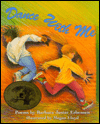
Dance With Me Ages 7-12

A joyous collection of poems celebrates many kinds of traditional and original dances, from the classic waltzes and tap dances to a dance with the wind and a gardener's dance with her hoe.
Subjects

Dance with Me
By Barbara Juster Esbensen
Illustrated by Megan Lloyd
Published by Harpercollins, 1995
ISBN 0060228237, 9780060228231
32 pages Ages 7, 8, 9, 10
A lovely collection of 15 poems, graced ...
... with iridescent pastel illustrations. Everyday objects and events are given a new charm in these verses that capture a rhythmic dance, from the tap-dancing of raindrops falling on the roof in a summer storm to the hidden music as a baby dances with her reflection in the mirror. Even such unlikely ""dancers"" as a gardener and basketball make appearances. Esbensen (Baby Whales Drink Milk, 1994, etc.) has a talent for choosing subjects, using rhythms, and finding language with ready appeal for her audience. Sunny or dramatic, Lloyd's illustrations deftly capture the tone of the accompanying verse. The pacing of the book is particularly nice: It begins with an invitation to the wind and the wind's reply, and ends with the still dance of sunlight through a dusty room. A fine addition to poetry and picture book collections, this is simple enough for reading alone and strong enough for group sharing.
Kirkus Reviews Copyright (c) VNU Business Media, Inc.
"Gr 3-6, Ages 9, 10, 11, 12 -- In 15 poems, all manner of dancers move to all sorts of rhythms and reveal unexpected images in the most delightful ways. Introducing the book with an invitation to partner the wind, Esbensen highlights such diverse subjects as bubbles, waves, and dust, and sees surprising choreography in everyday experiences. Even the visual arrangement of words on the page reinforces the verbal images and cadences that explore movement. Trees '...lock crooked arms/ and step across the lawn.' Mirages '...slide on invisible feet.' Raindrops are '...high-stepping/hoofers of summer.' There are people here, too; a baby tapping a beat to her mirrored reflection, a woman dancing a staccato rhythm as she weeds the garden, two grandparents gliding to a melody of memories. Lightning takes the exuberant stance of swordsmen, and children shadow dance and race in the sun. Lloyd's lovely crayon and pastel drawings add a floating lightness to each page and suggest, rather than tell, what the poet imagines. (As in Esbensen's Cold Stars and Fireflies (1984), Who Shrank My Grandmother's House? (1992), and Words with Wrinkled Knees (1987), all Harper/Collins), readers will find new discoveries and fresh delight in repeated readings." -- School Library Journal by Barbara Kiefer, Teacher's College, Columbia University, NY City

Wednesday, May 6, 2009

Home Ages 6-10

PREVIEW
Home. In this unique volume, prominent American writers from the past and present--Willa Cather, Henry David Thoreau, Eloise Greenfield--give voice to the region of the country each calls home. Thomas Locker's lavish oil paintings accompany each passage, transporting the reader from the crashing waves of the Pacific coast to the bluebonnet fields of the Texas prairie. Come along on a spectacular journey through our home--America.
Home: A Journey through America
By Thomas Locker, Candace Christiansen
Compiled by Thomas Locker
Illustrated by Thomas Locker
Edition: illustrated
Published by Houghton Mifflin Harcourt, 1998
ISBN 015201473X, 9780152014735
32 pages
Lush and romantic paintings of a broad ...... range of landscapes illustrate the poetry and prose of a dozen American authors and poets, whose homes ranged from the Hudson River Valley to the midwestern prairies and beyond. Each spread includes a poem or other brief block of text about home, as well as a biographical snippet about the featured writer. On the opposite page is a painting that illuminates an aspect of the writing; in general, Locker's landscapes are august and riveting. The selection of those included is a hybrid: some names seem written in stone (Frost, Irving, Thoreau, Cather, Sandburg), while others are still very much of the earth (Bruchac, Yolen, Greenfield, Locker). Nevertheless, from the East Coast to the West, the book shows how individual feelings about nature and home have shaped the artistic efforts of writers.
Kirkus Reviews Copyright (c) VNU Business Media, Inc.
From Publishers Weekly
This visual pilgrimage to the native terrain of a variety of venerable writers suffers from Locker's visually homogeneous treatment of America's diverse landscapes. The journey begins in San Francisco, Robert Frost's birthplace (though most readers likely equate the poet with New England). His "Once by the Pacific" is comprised of strong, clear images: the "great waves" that "thought of doing something to the shore/ That water never did to land before"; the clouds, "low and hairy in the skies." In Locker's painting, however, power is diverted from Frost's fierce flexure of the sea to a purple-to-black sky brooding over agitated water and cliffs glanced by light. Throughout Locker's tour, his brush seems dipped in the Hudson Valley light of his own homeland, and not surprisingly, the standout paintings here are those paired with an excerpt from Washington Irving's "Rip Van Winkle"?depicting a leisurely sail up the Hudson River, the boat dwarfed by the dramatic Kaatskill mountains aflame at sunset?and his own "Birches in the Fall" with white trunks leaning inward, inviting readers down an autumn trail of golden grasses. But when called upon to conjure the Southwest of Pat Mora's "Gold" or the Amish country depicted in Merle Good's "Song of a People," Locker fails to capture the indigenous palette and mood. Unfortunately, the book seems driven by its theme, rather than a celebration of it. Ages 6, 7, 8, 9, 10.
Copyright 1998 Reed Business Information, Inc.

From School Library Journal
Grade 3 Up-American landscapes as viewed via paintings and words. Locker and Christiansen have collected poetic and narrative views of scenes from across the continent by such well-known writers as Robert Frost, John Muir, and Washington Irving as well as modern writers such as Pat Mora, Jane Yolen, and Joseph Bruchac. The oil paintings, in true Lockerian tradition, reflect an inner view of landscape, one reminiscent of early British painters who came to paint American scenes but made each of them look like home. This romanticized approach, relying not on accuracy, perspective, or detail, but rather on creating a mood, may appeal to adults but the use of the same color palette, massive cloud effects, and little action will not capture the imagination or hold the interest of children.
Ronald Jobe, University of British Columbia, Vancouver, Canada
Copyright 1998 Reed Business Information, Inc.

Monday, April 27, 2009

I Know a Shy Fellow Who Swallowed a Cello Ages 4-7

PREVIEW
He's shy, a wallflower. He's the man at the side of the room listening to a duet for cello and viola. Even now you wouldn't notice him. But our shy fellow suddenly has an urge to swallow a cello, which is precisely what he does. And he doesn't stop there. He follows it with a harp, a sax, and a fiddle. On and on he goes, trying to satisfy his voracious appetite for musical instruments. A strange diet, you say? It's the perfect diet for a strange fellow, a strange, shy fellow. Barbara S. Garriel's wacky take-off on the old woman who swallowed a fly is the perfect match for John O'Brien's fertile and funny imagination.
I know a shy fellow who swallowed a cello
By Barbara S. Garriel
Illustrated by Barbara S. Garriel
Edition: illustrated
Published by Boyds Mills Press, 2004
ISBN 1590780434, 9781590780435
32 pages
Surreal illustrations add disturbing and ...... enjoyable vigor to this adaptation of "I Know an Old Woman Who Swallowed a Fly." The shy fellow is listening to a string duet when, much to the consternation of the cellist, he swallows the cello—"perhaps he'll bellow." This strange gentleman, now shaped like the cello he has swallowed, follows up with the harp from an Irish dance troupe, the saxophone from a jazz band, a cowboy's fiddle, a marching band's cymbal, the flute from a revolutionary war piper, and a birthday party's kazoo. With each addition to his strange meal, the shy fellow becomes more and more strangely shaped. At last he swallows the bell off a passing cat's collar—one snack too many!—and the resulting explosion returns the instruments to the musicians in a delightfully vibrant musical blast. The dynamic line of the illustrations, full of swoops and squiggles, provides excellent accompaniment to this silly reworking of a familiar rhyme. (Picture book. 4, 5, 6, 7)
Kirkus Reviews Copyright (c) VNU Business Media, Inc.

Saturday, April 25, 2009

Science Verse Ages 7-12

What if a boring lesson about the food chain becomes a sing-aloud celebration about predators and prey? Only the amazing talents of John Scieszka and Lane Smith, the team who created "Math Curse," could make science so much fun. CD Recording Included
Science Verse
By Jon Scieszka, Lane Smith
Illustrated by Lane Smith
Edition: illustrated
Published by Viking, 2004
ISBN 0670910570, 9780670910571
40 pages
In 1995, Mrs. Fibonacci laid a Math ...... Curse; this year, it's Mr. Newton who says, " . . . if you listen closely enough, you can hear the poetry of science in everything." What follows is a madcap collection of science poetry that lampoons familiar songs ("Glory, glory, evolution") and poems ("Once in first grade I was napping"). The whole lacks the zany unity of its predecessor, opting for an impressionistic tour of scientific terms and principles; the illustrations are less integrated into the text as well, if individually often quite inspired (a set of antiqued nursery rhyme panels are just perfect). Some of the poems rise to the level of near genius (" 'Twas fructose, and the vitamins / Did zinc and dye [red #8]"), while others settle for the satisfyingly gross ("Mary had a little worm. / She thought it was a chigger"). If this offering falls short of the standard set by Math Curse, it will nevertheless find an eager audience, who will hope that the results of Mr. Picasso's curse will soon be forthcoming. (Poetry. 8, 9, 10, 11, 12)
Kirkus Reviews Copyright (c) VNU Business Media, Inc.
Gr 2-5- Ages 7, 8, 9, 10, 11 In Math Curse (Viking, 1995), a ...
... teacher's chance comment causes a girl to see every aspect of her life as a math problem. This time around, the fun starts when a boy hears this remark: "-if you listen closely enough, you can hear the poetry of science in everything." What follows is a series of poems that parody the styles of Joyce Kilmer, Edgar Allan Poe, Lewis Carroll, Robert Frost, and many others, as well as familiar songs and nursery rhymes. "Once in first grade I was napping/When I heard a scary yapping" begins a lament about studying dinosaurs year after year. In "Astronaut Stopping by a Planet on a Snowy Evening," the narrator bemoans the fact that he can't figure out what planet he's on because "In science class I was asleep-." Children need not be familiar with the works upon which the spoofs are based to enjoy the humor, but this is a perfect opportunity to introduce the originals and to discuss parody as a poetic form. The dynamic cartoons are an absolute delight. The expressions on the face of the beleaguered boy keep readers smiling and the pages are chock-full of funny details that are in perfect sync with the poems. Printed in a cream-colored, readable font and set against solid backgrounds, the text is never overwhelmed by the frenetic illustrations. Fans of Scieszka and Smith will be in heaven, but the book will appeal to one and all.-Grace Oliff, Ann Blanche Smith School, Hillsdale, NJ

Arabella Miller's Tiny Caterpillar Ages 3-7

Keeping watch over a caterpillar leads to amazing surprises in a bright, buoyant read-aloud inspired by a children’s verse.
When Arabella Miller finds a tiny caterpillar, she brings him home and feeds him lots and lots of leaves. Soon the not-so-tiny caterpillar sheds his skin and disappears inside his chrysalis. Arabella misses her friend, but when he finally emerges, she is filled with wonder at the beautiful creature he has become. Clare Jarrett’s sweet story and vibrant illustrations weave details about a caterpillar’s transformation into this elaboration on the song "Little Arabella Miller."
Arabella Miller's Tiny Caterpillar
By Clare Jarrett
Illustrated by Clare Jarrett
Edition: illustrated
Published by Candlewick Press, 2008
ISBN 0763636606, 9780763636609
32 pages

Expanding a familiar preschool finger ...
... rhyme, Jarrett delivers an appealing (and singable) confection capped with a double spread of facts about the life cycle of the butterfly. By leading with two new verses, before inserting the well-known one, the author signals to children and caregivers that something fresh and new is in store. Carrot-haired Arabella, after the inevitable admonishment from mother, builds a shoe-box home for the caterpillar, feeds it ("Curly cabbage, crisp and crunchy, / frizzy parsley, fresh and munchy") and observes its changes, from multiple skin-sheddings, to chrysalis-building and metamorphosis. Jarrett's airy pencil-and-paper collages utilize variable perspective, a chiefly pastel palette and ample white ground to carry the simple text. Cleverly, saturated primary hues link the butterfly's markings with Arabella's bright hat and shirt. Pleasing and useful, for storytimes as well as one-on-one sharing. (Picture book. 3, 4, 5, 6, 7)
Kirkus Reviews Copyright (c) 2/1/2008 VNU Business Media, Inc.

Thursday, April 23, 2009

The Everything Book Ages 2-6

PREVIEW
ABCs, 1-2-3s, colors, shapes, nursery rhymes, finger games, and more...The Everything Book has something for everyone!
The Everything Book
By Denise Fleming
Edition: illustrated
Published by Macmillan, 2000
ISBN 0805062920, 9780805062922
64 pages Ages 2, 3, 4, 5, 6
PreS-Animals of all kinds, lively ...... insects and birds, and a diverse array of small children romp through this collection of simple rhymes, numbers and letters, and listings of familiar objects. The book includes everything needed to make it an anthology of preschool interests and concerns, from mealtimes to body parts. It even has traffic lights and trains. The very attractive illustrations, done in Fleming's characteristic bold and energetic style, were produced by pouring cotton pulp through hand-cut stencils, the result being simple forms that are attractively textured, with edges that are just fuzzy enough to look soft and friendly. The brilliant, warm colors are given depth and interest by the inevitable small differences in color produced by this process. Small children will enjoy pointing out the ladybugs crawling or flying or perched quietly on grass blades or leaves in almost every picture. There are, in all, 119 of them to be found, and doubtless young readers will spot every one. This is, indeed, an "Everything Book."-Marian Drabkin, Richmond Public Library, CA

My Teacher's in Detention

My Teacher's In DetentionMy Teacher's In Detention contains 50 hilarious poems about school that cover everything from homework and tests to detention and gross-out school lunches. The book contains poems by well-known poets, including Bruce Lansky, Jack Prelutsky, Kenn Nesbitt, and more great "giggle poets." Editor and contributor Bruce Lansky is one of North America's three bestselling authors of children's poetry books. His kid-tested, giggle-filled children's poetry books have sold over 2.5 million copies. This book follows on the success of Lansky's other school poetry anthologies, No More Homework! No More Tests!, and If Kids Ruled the School, which have sold over 500,000 copies in all editions and are among the best selling children's poetry books at retail.


About the Author

Bruce Lansky has been crowned the "King of Giggle Poetry" by his elementary school admirers. As editor of the successful poetry anthologies, Rolling in the Aisles, If Kids Ruled the School, A Bad Case of the Giggles, Kids Pick the Funniest Poems, No More Homework! No More Tests! and Miles of Smiles, he learned what makes children laugh by testing poems on panels of elementary and middle-school kids. He used this feedback to create books of his own original poetry, If Pigs Could Fly...and Other Deep Thoughts, and My Dog Ate My Homework.

http://www.poetry4kids.com/modules.php?name=News&file=article&sid=135

Poetry Fun Webpage

How to Get Kids Excited about Reading Poetry:
Make It Fun!

by Bruce Lansky

http://www.poetryteachers.com/poetclass/excitedpoetry.html

Thursday, April 16, 2009

Bing Bang Boing by D Florian Ages 6-12

Thirty-five Pages of Preview

Bing Bang Boing: Poems and Drawings
By Douglas Florian
Illustrated by Douglas Florian
Edition: illustrated
Published by Houghton Mifflin Harcourt, 1994
ISBN 0152337709, 9780152337704
144 pages
Meet Genny Glubber, who’s fat like blubber, and Mr. Giles, who has seven smiles. And Little-Naughty-Nasty Ned, who glued his brother to a bed. Come along and join the fun--this book has a poem for everyone! “From the sunlit yellow of its jacket to the humorous tone of its verse, this should prove a popular choice for poetry shelves.”--Booklist

Bing Bang Boing
By D. Florian
Published by Tandem Library, 1996
ISBN 0785778276, 9780785778271

An illustrated collection of more than 150 nonsense verses. Recommended by the AES Advisory Committee.
Ages 6, 7, 8, 9, 10, 11, 12

Laugh-eteria Ages 6-12

Thirty-eight Page Preview

Laugh-Eteria
By Douglas Florian
Illustrated by Douglas Florian
Edition: illustrated
Published by Houghton Mifflin Harcourt, 1999
ISBN 0152020845, 9780152020842
160 pages Ages 6, 7, 8, 9, 10, 11, 12
Karate Kids
One was a black belt. One was a brown. One had a loose belt; His pants fell down.
Silly, irreverent, and always clever, these poems showcase Douglas Florian’s talent for turning plain old language into outrageously entertaining verse. Page after page of witty wordplay and droll black-and-white drawings are guaranteed to knock the socks off devoted poetry fans and newcomers alike.
Florian's seventh collection of verse is ...
... also his most uneven; though the flair for clever rhyme that consistently lights up his other books, beginning with Monster Motel (1993), occasionally shows itself--""Hello, my name is Dracula/My clothing is all blackula./I drive a Cadillacula./I am a maniacula""--too many of the entries are routine limericks, putdowns, character portraits, rhymed lists that fall flat on the ear, or quick quips: ""It's hard to be anonymous/When you're a hippopotamus."" Florian's language and simple, thick-lined cartoons illustrations are equally ingenuous, and he sticks to tried-and-true subjects, from dinosaurs to school lunch, but the well of inspiration seems dry; revisit his hilarious Bing Bang Boing (1994) instead.
Kirkus Reviews Copyright (c) VNU Business Media, Inc.

Poetry by Douglas Florian Ages 6-12


April is Poetry Month

BEAST FEAST: POEMS


MAMMALABILIA


INSECTLOPEDIA


All by Douglas Florian


Ages 6, 7, 8, 9, 10, 11, 12

Comets, Stars, the Moon, and Mars Ages 6-12

PREVIEW
Comets, Stars, the Moon, and Mars: Space Poems and Paintings
By Douglas Florian
Illustrated by Douglas Florian
Edition: illustrated
Published by Houghton Mifflin Harcourt, 2007
ISBN 0152053727, 9780152053727
56 pages
Blast off with Douglas Florian's new high-flying compendium, which features twenty whimsical poems about space. From the moon to the stars, from the Earth to Mars, here is an exuberant celebration of our celestial surroundings that's certain to become a universal favorite among aspiring astronomers everywhere. Includes die-cut pages and a glossary of space terms.
Stunning mixed-media illustrations ...
... accompany a series of poems that celebrate the wonder and mystery of space. From the universe, the sequence narrows its focus to the galaxy, the solar system and then each body in turn, from the sun to poor demoted Pluto, and beyond. The verse is characteristically playful, wrapping itself around astronomical facts with ease. Readers will learn about the temperature and size of the sun, our moon's phases and Voyager 2's discovery of Neptune's rings. Delightful as the poems are, however, it's this volume's illustrations that surpass. Bright gouache on brown paper bags lend texture to each spread; stamped words allow the illustrations to incorporate such details as names of moons and "sun" in several different languages; collage elements add further whimsy to the whole. To top off this feast for the eyes, occasional die-cuts provide telescopic windows onto adjoining spreads, firmly establishing for the reader the truth that space is a vast continuum, with new surprises in every corner of the sky. Each poem receives a thumbnail gloss at the end, offering additional facts or extending the information presented earlier. Glorious. (Picture book/poetry. 7, 8, 9, 10, 11, 12)
Kirkus Reviews Copyright (c) 4/1/2007 VNU Business Media, Inc.
Gr 1–5 Ages 6, 7, 8, 9, 10, 11— Nothing gladdens the heart of ...
... believers in good poetry for children more than a new collection by Florian, whose verses and paintings consistently capture the essence of his featured themes. This one literally sings the music of the spheres. Twenty playfully lyrical poems treat topics such as the universe, the individual planets, constellations, and black holes. Each selection is presented on its own spread and adorned with a magical painting done in gouache, collage, and rubber stamps on brown paper. Circles abound in the artwork, and many pages have round cut-outs that lead into the next picture. For example, "the earth" ("Two-thirds water./One-third land./Valleys deep./Mountains grand") is illustrated with a colorful globe decorated with circled collage prints of animals and plants. A smaller orb appears nearby, made from a cut-out circle that reveals part of the illustration for the next selection, "the moon." Some of the paintings incorporate mythological names and images. The pleasing blend of faded shades and brilliant colors, of old-fashioned prints and fanciful sketches, makes the illustrations seem both antique and high-tech. An appended "Galactic Glossary" provides additional information. In both language and artwork, Florian strikes the perfect balance between grandeur and whimsy. Like Myra Cohn Livingston and Leonard Everett Fisher's Space Songs (Holiday House, 1988; o.p.), this book is a work of art worthy of the vastness of its subject.—Kathleen Whalin, York Public Library, ME

Monday, March 30, 2009

Love-Songs of Childhood

Book cover of Love-Songs of Childhood by Eugene Field

Excerpt:
Love-Songs of Childhood
By Eugene Field
THE ROCK-A-BY LADY

The Rock-a-By Lady from Hushaby street
Comes stealing; comes creeping;
The poppies they hang from her head to her feet,
And each hath a dream that is tiny and fleet
- She bringeth her poppies to you, my sweet,
When she findeth you sleeping!

There is one little dream of a beautiful drum
- Rub-a-dub! it goeth;
There is one little dream of a big sugar-plum,
And lo! thick and fast the other dreams come
Of popguns that bang, and tin tops that hum,
And a trumpet that bloweth!

And dollies peep out of those wee little dreams
With laughter and singing;
And boats go a-floating on silvery streams,
And the stars peek-a-boo with their own misty gleams,
And up, up, and up, where the Mother Moon beams,
The fairies go winging!

Would you dream all these dreams that are tiny and fleet?

They'll come to you sleeping;
So shut the two eyes that are weary, my sweet,
For the Rock-a-By Lady from Hushaby street,
With poppies that hang from her head to her feet,

Comes stealing; comes creeping.

Original Book Cover Art & Free Books

Book cover of Anne of Green Gables by Lucy Maud Montgomery

Book cover of Enchanted Castle, The by E. (Edith) Nesbit

Book cover of Peter Pan by J. M. Barrie

Book cover of Story of the Treasure Seekers, The by E. (Edith) Nesbit

Book cover of Wonderwings and other Fairy Stories by Edith Howes

A FEAST for the Eyes


Art washes away from the soul the dust of everyday life.
Every child is an artist.
The problem is how to remain an artist once he grows up.

Pablo Picasso (1881 - 1973)
In searching for sources of free audio books, I found
Books Should Be Free and rushed to the Children's Category.

http://www.booksshouldbefree.com/category.jsp?tag=4

Here I found a Treasure Chest of not only free text
(to continue reading on the screen or download as a plain text file)
and free audio MP3 files for downloading,
but also the original (perhaps) book cover art,
some of which are sampled here.
On the page, click on each for a larger view.

If nothing else, with your child compare (contrast)
the covers of Peter Pan or Anne of Green Gables
with the current ones
and talk about which s/he likes better and why.
MI: Interpersonal and Intrapersonal

Without having technical knowledge, we each know what appeals to us.
Explore the art in your library (MI:Kinesthesic, Visual) or online (MI: Visual).
And, no matter how you value Picasso,
at least for me, I agree with him -
art washes away from my soul

the dust of everyday life and fills it with beauty.
Give yourself and another this gift, won't you?

Book cover of Voyages of Doctor Dolittle, The by Hugh Lofting

Book cover of Burgess Animal Book for Children, The by Thornton W Burgess


Monday, March 23, 2009

WRITE POETRY IN CYBERSPACE!

http://www.readwritethink.org/materials/acrostic/

Try the acrostic poetry tutor and interactive at ReadWriteThink,
sponsored by the National Council of Teachers of English.

This bouncy, pleasantly popping student stimulator asks,
answers, and gives an example (SUN) of what an acrostic poem is.

(You may turn off the sound by clicking the SPEAKER icon.)

It's a great starting point for writing first poems.

Try a NAME poem or a one- or two-word TOPIC poem.
Mine was Washington, D.C. Use up to 15 character spaces.

Enter your name in up to 15 character spaces.

Brainstorm a list of MY WORDS or phrases to use in your poem.
Each of the eight (8) lines will hold 20 characters,
but shows only 16 characters, when this list reappears later.
Here, too, is the option to EXIT,
which remains an option through the next steps.

Seven (7) lines then appear with each letter of your
NAME or TOPIC arranged vertically and capitalized.
UP and DOWN ARROWS allow access to other letters in longer words.

Up to seven (7) HINT words appear for each letter, as you point to it.
These are mostly conjunctions, adjectives, adverbs and verbs,
which may be helpful.
"X" suggests that you should "Be Creative!"
and gives three (3) "ex-" words.

The MY WORDS list remains visible.

When you complete the poem, it appears in PRINTABLE form with
"Acrostic Poems," your TITLE and NAME, and completed poem below.

A ZOOM feature and BACK button for changes are here.
Choose to PRINT before you write a NEW POEM.
Nothing is saved here.

You may revise and move BACK or CONTINUE indefinitely,
until you PRINT or choose NEW POEM.

Happy Writing!

Sunday, March 22, 2009

ELEMENTS OF POETRY
FIGURATIVE LANGUAGE FLASHCARDS


FLASH CARDS OF 24 TERMS

click below

Elements of Poetry- Figurative Language